The story · Studio B, 1960
During the session, part of the studio’s sound board breaks.
So Grady Martin’s bass guitar comes out fuzzy, a buzzing, broken sound.
Engineer Glenn Snoddy is called in to fix it.
But producer Don Law keeps the sound.
THE MAYBELLE PROJECT
OPENING
Maybelle, the living memory of music.
The stories behind American music are disappearing.
We find the people who were there and connect what they remember.
And we’re asking a few people to help.
The story · Studio B, 1960
1961.
“Don’t Worry,” the hit with fuzz guitar.
Depends who you ask. Some say “Rocket 88,” 1951. Some say Link Wray’s “Rumble,” 1958. Every story is part of the history.
In his own words
“It had a real distorted fuzzy sound to it.”
1962.
Snoddy builds a circuit that makes the fuzz on purpose. Gibson sells it as the Maestro Fuzz-Tone.
In his own words
“Well, they didn’t develop it; I developed it and presented it to them.”
1965 and on.
Keith Richards of the Rolling Stones plugs one in for “Satisfaction.” Then everyone does.
Everyone who was there tells it their own way. Every story is part of the history.
Then radio and records arrived, and the whole country heard the same recordings.
IN HIS OWN WORDS
“I beg the co-operation of all who are interested in this vital, however humble, expression of American literature.”
Computers and AI only learn from what was written down. Most of these stories never were. The people who lived them won’t be here forever.
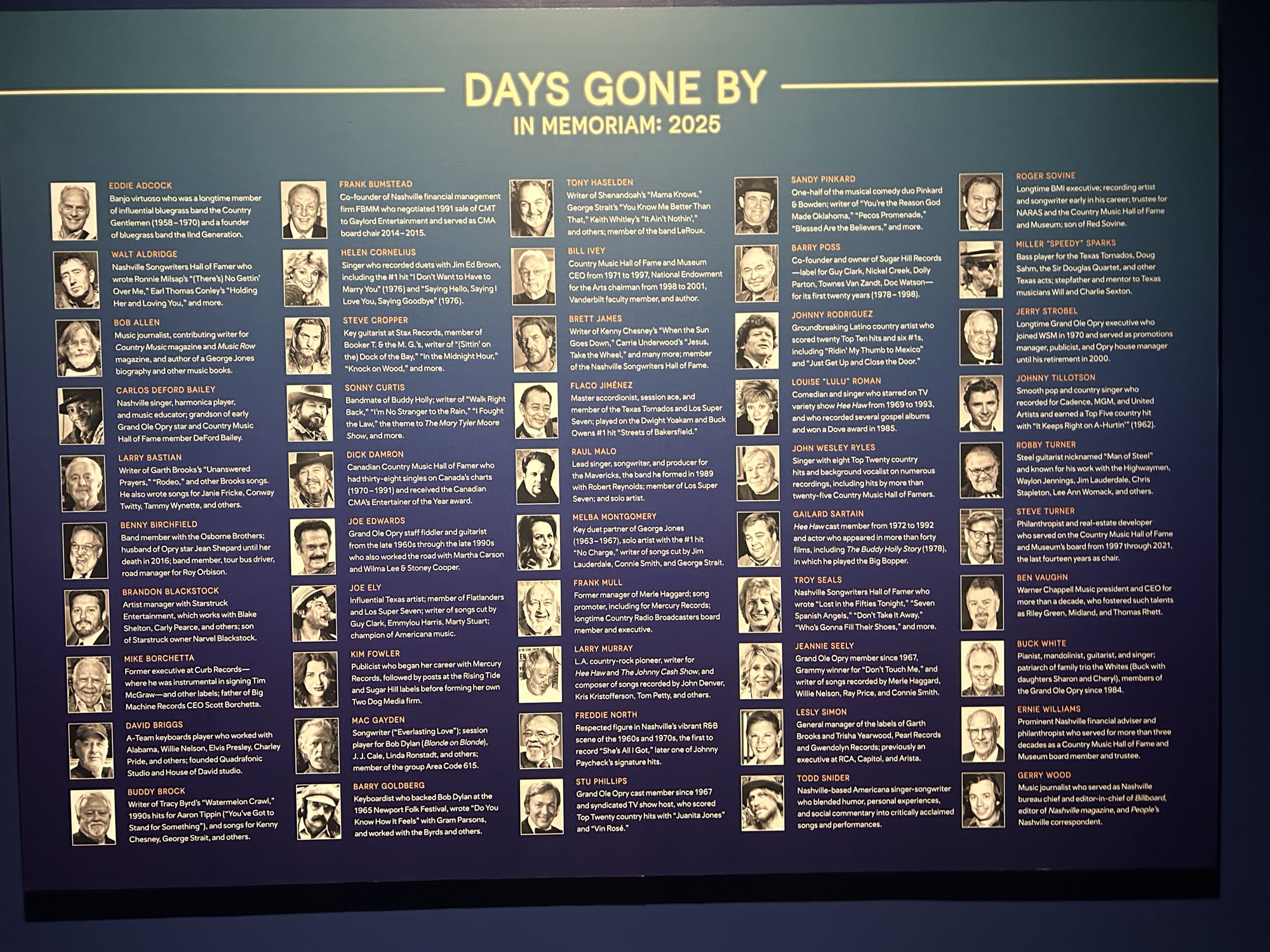
Fifty names on one wall at the Country Music Hall of Fame. Each of them knew things no record holds.
“DAYS GONE BY · IN MEMORIAM: 2025”
COUNTRY MUSIC HALL OF FAME AND MUSEUM
We save seeds now.Like Lomax, we don’t wait to know why. A story is worth keeping the day it’s told.
Story creates value.A song means more when you know where it came from. A guitar is worth more when you know who played it.
David Gilmour’s “Black Strat,” the guitar he played on Pink Floyd’s The Dark Side of the Moon, sold at Christie’s for $3,975,000 in 2019. In March 2026 it sold again, for $14.55 million.
Influence is music’s real family tree.Every musician learned from someone. Every sound came from somewhere, even a broken amplifier. We trace the inheritance, every version.
Every voice counts, even the tall tales.The player, the engineer and the fan up front each saw something different. Some stories agree, some don’t, and some get bigger every time they’re told. All of it is part of the story.
The faster the world moves, the more people matter.Technology should bring us back to each other. As everything speeds up, people come first.
The stories are disappearing.
We’re saving them.
Help us.
Our first River: everything that grew from John Lomax’s recordings.
Have a story? Meet Maybelle.
Jonathan Sexton · js@inthewld.com